Air pollution control

Industrial wet scrubbers for clean air

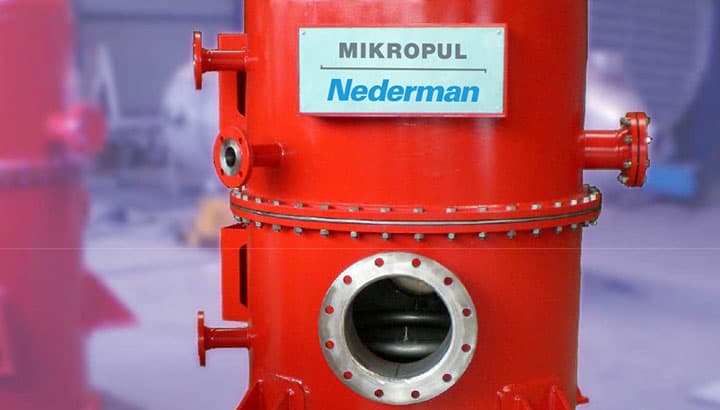
Nederman MikroPul has been a pioneer worldwide in wet scrubbers, solving air pollution control problems across heavy industry. Our scrubbers are engineered to greater than 99% efficiency and configured to your process - in mild steel, FRP or stainles steel.

Dynamic-Scrubber1

The Basics

What is a wet scrubber?

A wet scrubber is an air pollution control device that removes particulate matter, acid gases, fumes, and odors from an industrial gas stream by bringing that stream into intimate contact with a scrubbing liquid.

Where a dry collector traps dust on a filter medium, a wet scrubber transfers the contaminant into liquid. Particles are captured when they collide with droplets. Gasses are captured by absorption into the liquid, often with a reagent that neutralizes them chemically. The wetted contaminant is then separated from the gas stream and drained away as a slurry, and clean gas leaves the unit.

That is the difference why wet scrubbers are selected for duties dry collection struggles with: sticky or hygroscopic dusts, high gas temperatures, combustible or explosive dusts, condensing moisture, and gas streams where particulate and acid gas have to be removed together.

What a wet scrubber removes

  • ParticulateSub-micron through coarse dust, including PM2.5
  • Acid gasesHandled at high concentration by packed bed designs
  • Basic gasesNeutralized with the appropriate reagent
  • Fumes & aerosolsCondensed metallurgical and process fumes
  • OdorsRotary and packed bed scrubbers, including odor control duty

Reagent selection depends on the chemistry being treated. Common choices include caustic (NaOH), sulfuric acid (H2SO4), phosphoric acid and sodium hypochlorite.
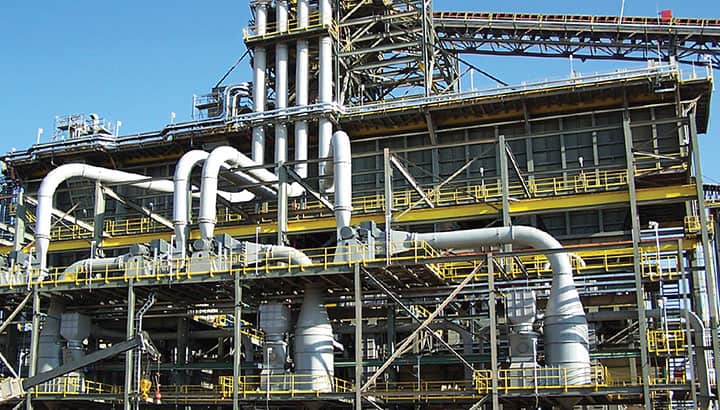
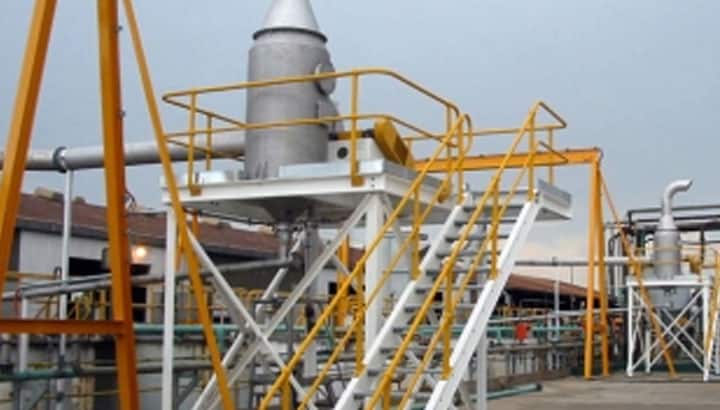
Why should you choose Nederman MikroPul wet scrubbers?

High Efficiency,
Low Operating Cost

We can optimize wet scrubber performance and design for your application which can achieve > 99% efficiency. Our wet scrubbers can be configured to meet your requirements and are available in mild steel, FRP, or stainless steel.

Nederman MikroPul has been a pioneer worldwide in providing wet scrubbers to solve air pollution control problems for almost 50 years. We offer designs to meet almost any requirement — in several configurations and a full range of sizes. Numerous materials of construction include carbon steel, plastics/FRP, and exotic alloy steels. Nederman MikroPul has the demonstrated capability to engineer a wet scrubber system that efficiently meets your needs.

> 99%
Efficiency for gaseous pollutants
Experienced
Decades of experience in wet scrubbers
6
Wet scrubber technologies
Available in
Mild steel, FRP, or stainless steel

Principle of operation

How a wet scrubber works

Every wet scrubber does the same four things - contact, capture, separate, drain. What changes between technologies is how the energy for that contact is supplied: gas velocity through a venturi throat, a rotating atomizer wheel, a wetted fan, or the surface area of a packed bed.

1

Dust-laden gas enters the scrubber and is brought into contact with scrubbing liquid introduced into the gas stream.

2

Energy input - velocity, rotation or packing surface - breaks the liquid into find droplets and disperses them across the full flow cross-section.

3

Particles collide with droplets and are wetted; soluble gasses are absorbed into the liquid phase and neutralized by the reagent.

4

Centrifugal action and inertial separation pull the heavy wetted particles out of the gas stream toward the vessel walls.

5

The dust and liquid mixture is washed down the walls and drains from the bottom of the separator as slurry.

6

A mist eliminator or demisting vane removes residual droplets, and cleaned gas exists the unit.

Design note.

Continuous blow-down with fresh water makeup keeps solids concentration under control and reduces downtime. Several Nederman MikroPul designs, including the Mikro-Vane scrubber, are built to tolerate high solids content in the recycled water.

Product Range

Six wet scrubber technologies

Our designs are offered in several configurations and a full range of sizes. Each technology solves a different combination of particle size, inlet loading, gas chemistry, and available pressure drop.

High Efficiency Venturi Wet Scrubber

Venturi Scrubber

Accelerates contaminated gas through an adjustable throat where it collides with scrubbing liquid, trapping the sub-micron particles other collectors miss. the wet-approach design introduces liquid tangentially, so the stream swirls along the converging walls before the throat.

  • Efficiency99.9%+ on sub-micron particles; above 99.9% for PM2.5
  • HandlesHigh inlet gas temperature and high dust loading
  • MaintenanceVery few moving parts; open pipe inlets, no spray nozzles
  • FootprintSmaller than comparable dry collection equipment
Dynamic Wet Scrubber with wetted fan

Dynamic Scrubber

A dynamic wet scrubber with an integral wetted fan, removing dust, aerosols and gasses in a single unit. Widely applied in metals and chemical processing, plus dust control on spray drying and incineration plants, and odor control duty.

  • EfficiencyHigh on both solid and gaseous pollutants
  • Pressure dropmax 1.2 kPa (5 in. w.g.)
  • StagingMultiple scrubbing stages can be applied
  • DemistingVarious mist eliminator devices available
Mikro-Vane Wet Scrubber

Mikro-Vane Scrubber

Built for heavy inlet dust loading with no moving parts at all. The vane design holds collection efficiency up while keeping water consumption, water pressure and maintenance demand low.

  • Efficiency99+% at around the 5 micron size range
  • Pressure drop1.2 kPa (5 in. w.g.)
  • WaterLow consumption and low supply pressure
  • RecycleTolerates high solids content in recycle water
Rotary Wet Scrubber MRW

Rotary Scrubber (MRW)

A rotating atomizer wheel sends centrally supplied liquid through guide vanes to form a thin film, which breaks into fine droplets at the wheel's outer edge — creating a liquid curtain across the entire flow cross-section. Droplet size is set by wheel speed and liquid flow rate.

  • RemovesFine dust, harmful gases and odors
  • StagesOne or two stage; optional second atomizer wheel
  • WaterLow fresh water consumption
  • InstallVertical or horizontal; small footprint
Packed Bed Scrubber

Packed Bed Scrubber

A cost effective solution for treating gaseous pollutants. Packed bed scrubbers neutralize a wide range of contaminants and handle high concentrations of both acidic and basic species, in a compact vessel with low capital cost.

  • DutyNeutralizes numerous gaseous pollutants
  • ConcentrationHigh acidic and basic contaminant loading
  • Inlet temp.Up to 1800°F
  • EngineeringVessel, packing/components custom
Two Stage Wet Scrubber

Two Stage Scrubber

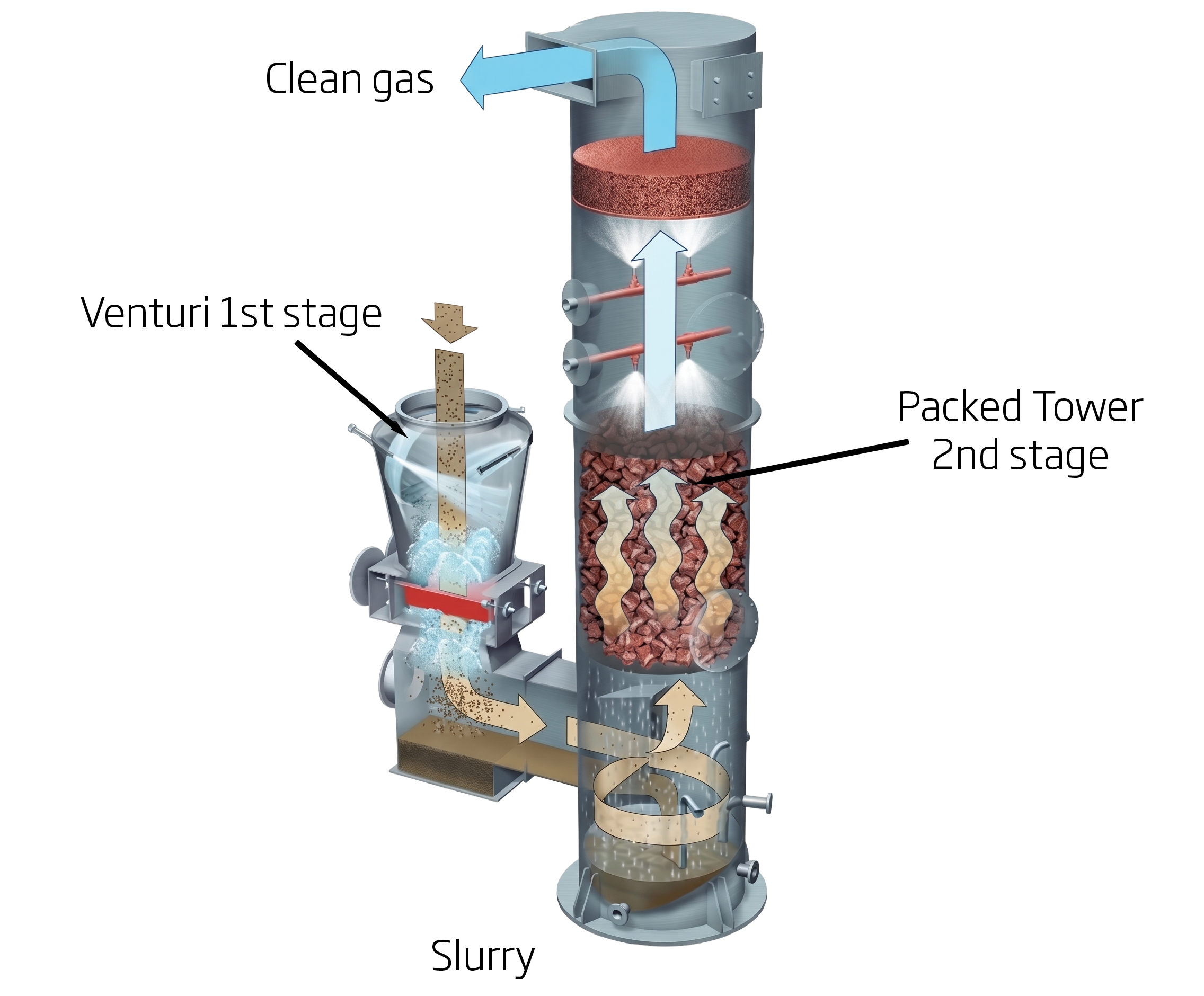
Completely engineered systems combining multiple scrubber technologies in one vessel — a packed tower with integral venturi and chimney tray keeping separate liquid loops, or a Multi-Venturi rod deck ahead of a dynamic or Mikro-Vane stage.

  • GainsHigher particulate removal at lower pressure drop
  • AbsorptionTwo-stage capability for acidic and basic gases
  • OptionsQuench and condensing sections available
  • SavesPlant space, pressure drop and equipment train

Selection Guide

Choosing the right industrial wet scrubber

Wet scrubber comparison — specifications as published on each product page

TechnologyPrimary targetStated efficiencyPressure dropDistinguishing trait
VenturiSub-micron particulate, PM2.599.9%+-Adjustable throat; handles high temperature and high dust loading
DynamicDust, aerosols and gases togetherHigh on solids and gasesmax 1.2 kPa (5 in. w.g.)Integral wetted fan; multiple scrubbing stages
Mikro-VaneHigh inlet dust loading99+% at ~5 µm1.2 kPa (5 in. w.g.)No moving parts; tolerates high solids in recycle water
Rotary (MRW)Fine dust, harmful gases, odors--Atomizer wheel; low fresh water use; vertical or horizontal
Packed bedAcidic and basic gases--Inlet gas up to 1800°F; compact, low capital cost
Two stageParticulate and gas in one trainHigher than single stageLower than equivalent separate stagesOptional quench and condensing sections


Dashes indicate figures not published on the corresponding product page. Request the technical data sheet for application-specific performance.

Materials of construction

Wet scrubbers are configured to your requirements in mild steel, FRP or stainless steel. A wide choice of construction options lets the vessel be matched to the process chemistry rather than the other way around.

Scrubbing reagents

Common reagents include caustic (NaOH), sulfuric acid (H2SO4), phosphoric acid and sodium hypochlorite. Selection depends on the chemical being treated.
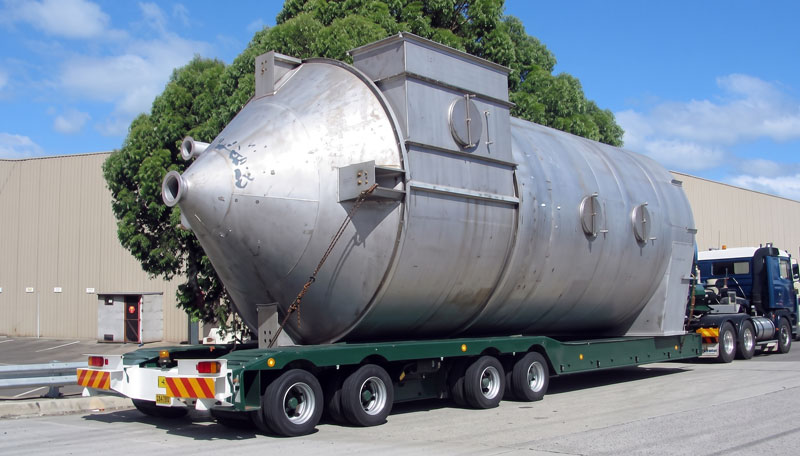
Multi-stage arrangements

Venturis can be arranged in series where more complete particle removal is needed than a single stage can achieve. The Multi-Venturi rod deck reaches higher efficiencies at lower pressure drops, with a two-stage demisting zone that removes 90% of water before the final demist vanes.

Technology comparison

Wet scrubbers vs. dry collection

A baghouse or cartridge collector separates dust onto a filter medium and discharges it dry. A wet scrubber transfers it into liquid. Neither is universally better — the process decides.

Wet scrubbing earns its place where the gas stream is hot, humid, sticky, corrosive or combustible, or where a gaseous pollutant has to be absorbed alongside the dust. It also takes up less room: MikroPul venturi scrubbers occupy a smaller footprint than comparable dry collection equipment.

The trade is a liquid effluent stream to manage and, on high-efficiency designs, the energy cost of pressure drop. Continuous blow-down with fresh water makeup keeps the recirculating liquid within specification and reduces downtime.

When wet scrubbing is the right call

  • Sub-micron particulate that dry media cannot hold
  • High inlet gas temperature
  • High humidity or condensing moisture in the gas stream
  • Explosive or combustible dust
  • Acid or basic gases requiring absorption and neutralization
  • Odor control duty
  • Limited plant space for an equipment train

Where are they used

Industries and applications

MikroPul wet scrubbers are installed across heavy industry — anywhere a process gas stream carries dust, fume or gas that has to be removed before it reaches the stack.

Asphalt Cement Crematories Carbon black Chemical Energy MetalsPower generationTextilesMining & mineralsPulp & paperFood

Mining & minerals

Uranium, copper and zinc ore processing, potash minerals, lime kilns and lime shakers, dissolving tanks, flotation cells and general dedusting.

Metals

Fume and particulate capture across metals processing, including HCl and particulate removal in aluminum refining.

Chemical & process

Dryers and polypropylene dryers, calcining, reagent preparation, autoclave and fertilizer duty, spray drying plants.

Thermal & waste

Waste incineration, combustion applications, crematory emissions and odor control.

Support

Extend the life of your equipment

Onsite assessment

Evaluation of your existing air pollution control equipment and process conditions before anything is specified.

Spare parts

OEM parts for MikroPul scrubbers, keeping performance and warranty conditions intact.

Field maintenance

Scheduled and corrective field service to keep collection efficiency and pressure drop where they were designed to be.

Common things to know

Frequently Asked Questions

Answers to common questions about industrial wet scrubbers

Loading component...

Loading component...

Loading component...

Loading component...

Loading component...

Loading component...

Let's Solve Your Problems

Talk to a Process Technology Expert Today

Connect with Nederman MikroPul to improve your dust collection.

Loading component...